What Is Media Literacy? A Practical Guide to Evaluating News and Online Information
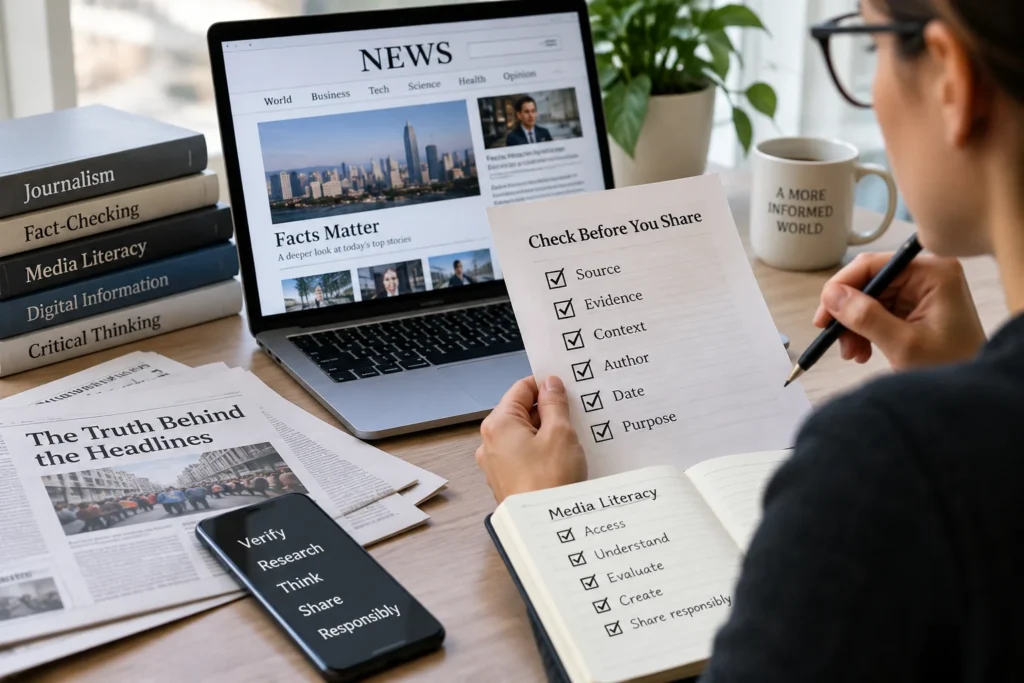
Media literacy is the ability to access, understand, evaluate, create, and share media and information responsibly. It applies to news articles, television reports, podcasts, videos, social media posts, advertisements, search results, charts, public statements, and AI-assisted content.
In practical terms, media literacy means asking how a message was produced, who is responsible for it, what purpose it serves, what evidence supports it, what context may be missing, and how confidently it should be shared. It does not require readers to reject unfamiliar sources or accept familiar ones automatically.
UNESCO describes Media and Information Literacy as supporting critical engagement with information, safer navigation of the online environment, and greater trust in the information ecosystem. These skills are useful because information can be accurate, incomplete, outdated, promotional, misleading, or false in different ways.
This guide explains the main principles of media literacy and shows how to apply them to news, social media, advertising, visual content, artificial intelligence, research, and everyday online decisions.
What Media Literacy Includes
Media literacy is not one test or a single ability. It combines several related practices.
Accessing Information
Access means knowing how to locate information, open the original source, use search tools, and identify whether a screenshot, repost, or summary leads back to a real publication or document.
Finding information is only the beginning. A search result, social post, or shared image may not show the original wording, date, author, or surrounding context.
Understanding the Message
Understanding requires attention to format, language, audience, and presentation. A news report, opinion article, advertisement, press release, satire post, and research paper may discuss similar subjects while serving very different purposes.
The same sentence can also create a different impression when placed in a headline, caption, video clip, or promotional page. Media literacy helps readers examine the complete message instead of reacting to one isolated element.
Evaluating the Source and Evidence
Evaluation involves checking who created the material, what the source knows, how the claim is supported, and whether the evidence actually matches the conclusion.
A professional design or confident tone can make information appear reliable, but neither one proves that the underlying claim is accurate. The source, evidence, context, and accountability signals deserve closer attention.
Recognizing Purpose
Media content may be created to inform, explain, persuade, sell, entertain, attract attention, encourage participation, or influence opinion. A message can serve more than one purpose.
Recognizing the purpose does not automatically determine whether the information is true. It helps readers understand what type of scrutiny is appropriate and whether the content should be read as reporting, interpretation, promotion, or advocacy.
Creating and Sharing Responsibly
Media literacy also affects what people publish and distribute. Responsible sharing means preserving important qualifications, identifying opinion as opinion, labeling commercial relationships, linking to original material, and avoiding claims that the available evidence cannot support.
A person does not need complete certainty about every detail before discussing a subject. However, uncertainty should not be hidden or replaced with stronger language than the evidence allows.
Why Media Literacy Matters
People encounter information through many channels at different speeds. These channels are part of a broader digital media environment in which information can be published, discovered, shared, and reshaped across different formats. A complete article may be reduced to a headline, a short clip, a screenshot, a quote card, or a post with no link to the original source.
This can separate a claim from its date, author, evidence, and limitations. Information that was accurate in one setting may become misleading when an old image is presented as current, a partial quotation is shown without surrounding remarks, or a statistic is removed from the population and time period it describes.
Commercial and editorial material can also appear in similar formats. A sponsored article, affiliate recommendation, press release, product review, and independently reported story may all use headlines, images, and paragraphs. Readers need enough awareness to recognize the difference.
Media literacy is especially useful when a claim could affect health, finances, legal decisions, personal safety, professional reputation, or public understanding. In such situations, readers should rely on primary records and qualified sources instead of treating a general online article as a final authority.
What Media Literacy Is—and Is Not
Media literacy is:
- a process for examining information carefully;
- a way to separate evidence from interpretation;
- a habit of checking source, purpose, context, and limitations;
- a method for making sharing decisions responsibly; and
- an approach that can be updated when better evidence appears.
Media literacy is not:
- an automatic detector that identifies every false claim;
- proof that one publication is permanently reliable or unreliable;
- a reason to distrust every institution, journalist, or expert;
- the same as agreeing with a message;
- limited to political news or current events; or
- replaced by a verified badge, large following, familiar logo, or polished website.
The aim is disciplined evaluation rather than automatic belief or automatic dismissal.
Media Literacy and Related Skills
Several terms overlap with media literacy but are not identical.
| Skill | Main focus |
| Media literacy | Understanding, evaluating, creating, and sharing messages across different media formats |
| News literacy | Assessing journalistic reporting, sourcing, verification, attribution, and editorial decisions |
| Information literacy | Identifying an information need, finding relevant material, evaluating it, and using it appropriately |
| Digital literacy | Using devices, platforms, software, and online services effectively and safely |
| Critical thinking | Reasoning from evidence, identifying assumptions, comparing explanations, and revising conclusions |
These skills support one another. Someone may know how to use a search engine but still need media literacy to judge the quality and purpose of the results.
Begin With the Claim, Not the Reaction
Before evaluating a post or article, restate its central claim in neutral language. This helps separate what the content actually says from the emotional response it creates.
Ask whether the statement is:
- a verifiable fact;
- an allegation attributed to someone else;
- an interpretation of known information;
- a prediction about the future;
- an opinion or value judgment; or
- a question that remains unresolved.
A headline may contain several claims at once. The article may support one of them while leaving another uncertain. Reading the body, captions, linked documents, and update notes helps reveal whether the headline accurately represents the material.
A Practical Media Literacy Framework
1. Identify the Publisher and Author
Check the exact domain, publication name, author, publication date, update date, and any available ownership or contact information.
An About page or author biography can provide useful context, but it should not be treated as proof of every claim made by the publication. Look for information that can reasonably be checked, such as the writer’s role, subject coverage, and responsibility for the material.
A missing byline does not automatically make a report false. Institutional announcements, government notices, wire briefs, and staff reports may be published under an organization’s name. The important question is whether responsibility is clear enough for readers to understand who issued the information.
Be careful with copycat domains, unusual spellings, misleading subdomains, and pages that imitate the appearance of established publications.
2. Understand the Purpose and Audience
Ask what the content is trying to accomplish. It may be reporting an event, explaining a process, promoting a service, presenting an argument, reviewing a product, or attracting attention through an emotional presentation.
Look for labels such as:
- Opinion
- Analysis
- Editorial
- Advertisement
- Sponsored
- Affiliate
- Partner content
- Press release
- Review
A commercial relationship does not automatically make information inaccurate. It does mean that readers should understand the relationship and assess promotional claims carefully.
3. Trace Important Claims to Evidence
Important claims should lead to identifiable supporting material. Depending on the subject, this may include an official record, court filing, research paper, dataset, transcript, direct interview, company announcement, or firsthand observation.
Read the original evidence whenever possible. A link to a homepage, search result, unrelated article, or another page repeating the same statement does not establish that the claim is correct.
Also consider what the source actually proves. A company announcement can confirm what the company said, but it may not independently establish that every benefit or prediction in the announcement will occur. A government document may confirm an official position while leaving questions about implementation or impact unanswered.
For a more detailed source-verification process, examine the origin, evidence, context, corroboration, and uncertainty surrounding the claim.
4. Restore the Full Context
Information may become misleading when its date, location, surrounding statements, or qualifications are removed.
Check:
- when the event happened;
- where it happened;
- who made the original statement;
- what came before and after a quotation;
- which population or period a statistic describes;
- whether the material has been updated;
- whether an image or video is being reused in a different setting; and
- whether the headline says more than the article establishes.
The purpose of context-driven reporting is to connect a development with the background and evidence needed to understand its significance. Context should clarify the subject without burying the main fact beneath unrelated detail.
5. Compare Independent Coverage
Several websites repeating the same wording may all be relying on one original post, press release, or unverified account. Repetition is not the same as independent confirmation.
Stronger corroboration may involve separate interviews, independently obtained documents, different observations, local reporting, or data gathered through distinct methods.
When sources disagree, compare:
- the quality of each source’s evidence;
- whether the source was in a position to know;
- whether important claims are clearly attributed;
- how uncertainty is described;
- whether later updates changed the account; and
- whether one report simply copied another.
For developing events, responsible reporting may leave some details unresolved. A clear statement of uncertainty is preferable to speculation presented as fact.
6. Check Dates, Updates, and Corrections
An older article is not automatically unreliable. It may accurately describe what was known at the time of publication. However, the situation may have changed, or later evidence may have corrected an earlier conclusion.
Check the original publication date, update history, correction notes, and references to later developments. This is especially important for emergencies, elections, court proceedings, product announcements, scientific findings, and rapidly changing technology.
A correction does not necessarily show that an entire publication is unreliable. Transparent corrections can show that a publisher has a process for responding to material errors. Readers should assess the seriousness of the error, how it was handled, and whether the corrected version now reflects the available evidence.
7. Examine Numbers, Research, and Quotations
Numbers can appear precise while leaving their meaning unclear. Before relying on a statistic, ask:
- Who collected the data?
- What exactly was measured?
- Which period does it cover?
- How was the sample selected?
- Is the figure a total, average, percentage, estimate, or projection?
- What is the relevant denominator?
- Are limitations or margins of uncertainty explained?
- Does the conclusion go beyond what the data shows?
A change occurring after another event does not by itself prove that one caused the other. Research findings should be read with attention to the study design, population, comparison, and stated limitations.
Quotations also need context. Look for the full interview, transcript, speech, filing, or official statement when available. Confirm the speaker, date, wording, and surrounding remarks. A shortened quotation may remain technically accurate while creating a different impression from the complete statement.
8. Inspect Images, Video, Audio, and AI-Generated Material
Visual material should be evaluated separately from the caption attached to it. A genuine photograph can be paired with an inaccurate description, and real footage can be cropped, edited, slowed, translated incorrectly, or presented as a different event.
Useful questions include:
- Where did the image or recording first appear?
- Does the date match the claimed event?
- Are landmarks, signs, weather, clothing, or vehicle markings consistent with the location?
- Has the material been edited or excerpted?
- Does the original creator or agency provide relevant context?
Reverse image searches and other verification tools may help locate earlier versions or related pages, but a search result is not a universal authenticity verdict. Failure to find an earlier copy does not prove that the material is genuine.
AI-generated or AI-assisted text, images, audio, and video require the same basic evaluation. Realistic appearance is not evidence of accuracy, and the presence of AI does not automatically make a claim false. Check provenance, supporting records, original sources, and independent corroboration. A detection tool should be treated as one signal rather than final proof.
9. Notice How the Content Was Distributed
The place where information appears can influence how people encounter it. A search result, recommendation feed, messaging app, newsletter, video platform, or social network may present only a headline, excerpt, thumbnail, or short caption.
Visibility is not editorial verification. A high view count, large following, familiar account, repeated repost, or platform badge does not establish that a claim is correct.
Open the original page when possible. Check whether the account is the original publisher, an individual commenter, an organization, or a page repeating information from somewhere else. Comments and reactions may provide leads, but they are not independent evidence by themselves.
10. Decide How to Share the Information
After reviewing the source and evidence, decide whether the material should be shared, qualified, delayed, or left unresolved.
If you share it:
- link to the original source;
- preserve important qualifications;
- identify whether the material is reporting, opinion, advertising, or analysis;
- avoid stronger wording than the evidence supports; and
- correct your own post if a significant error becomes clear.
If essential evidence remains unresolved, do not present the claim as an established fact. Waiting for better information is a responsible decision, not a failure to participate.
Applying Media Literacy to News Reports
News reporting has recognizable conventions, although the format varies by publication and medium. Readers who want to understand a news-report format can examine the headline, lead, attribution, evidence, relevant perspectives, supporting detail, updates, and corrections.
When reading a report, ask:
- Does the headline accurately reflect the body?
- Is the main development identified near the beginning?
- Are important claims attributed to their sources?
- Does the report distinguish direct observation from another party’s statement?
- Are allegations presented as allegations rather than established facts?
- Has the relevant subject had an opportunity to respond?
- Are meaningful limitations or uncertainties disclosed?
A press release may provide useful facts, quotations, and documents, but it represents the issuing organization’s position. A news report may use that material while adding independent verification and context. An opinion article may examine the same subject from an identified viewpoint. These formats should not be treated as interchangeable.
Anonymous sources are not automatically unreliable. Reporters may protect a source when disclosure could create a serious risk. Readers should still look for an explanation of why anonymity was necessary, how much the publication knows about the source, and whether other evidence supports the account.
Advertising, Sponsorship, and Persuasive Content
Some promotional content is designed to resemble ordinary editorial material. Readers should look for clear labels and disclosures before treating a page as independent reporting.
The Federal Trade Commission’s guidance on native advertising explains that commercial content should not mislead people about its advertising nature. When a disclosure is necessary, it should be clear, prominent, understandable, and placed close to the content it identifies.
A disclosure does not prove that every commercial claim is accurate. It simply helps readers understand the relationship behind the message. Promotional statements should still be assessed for evidence, limitations, and relevance to the reader’s decision.
Understanding Misinformation, Errors, and Intent
Inaccurate information can result from mistakes, misunderstanding, outdated material, poor sourcing, edited context, satire, manipulation, or deliberate deception. A reader may be able to show that a claim is inaccurate without being able to prove why it was published or shared.
For that reason, it is safer to describe the observable problem:
- unsupported;
- inaccurate;
- out of context;
- outdated;
- incorrectly attributed; or
- contradicted by stronger evidence.
Do not assign a motive solely because a post is wrong or poorly sourced. A careful evaluation separates what can be demonstrated from what remains an assumption about intent.
Media Literacy Beyond News
Media literacy also applies to information about technology, artificial intelligence, products, services, business, health, finance, education, and public policy.
When evaluating technology or AI claims, check what the product or system actually does, which documentation supports the statement, what limitations are disclosed, and whether a promotional page is being treated as independent testing.
For health, legal, financial, and safety matters, general online explanations should be treated as background information. Official records, original research, qualified professionals, and responsible organizations deserve greater weight for decisions with serious consequences.
When reading product reviews or recommendations, identify affiliate relationships, sponsorships, selection criteria, testing methods, and whether the writer has disclosed relevant limitations. A positive or negative conclusion should be connected to observable reasons rather than treated as proof on its own.
How Publications Can Support Media Literacy
Publications can make evaluation easier by showing who is responsible for an article and how its claims were assembled.
Helpful practices include:
- clear bylines or organizational responsibility;
- accurate headlines;
- publication and update dates;
- links to relevant source material;
- clear labels for opinion, analysis, advertising, and sponsorship;
- a visible corrections process;
- contact information for factual concerns; and
- explanations when important information remains uncertain.
These signals do not guarantee that every article is correct. They give readers a practical way to question, verify, and report problems. A publication’s publication accountability is meaningful when it can be observed in the way content is sourced, labeled, corrected, and updated.
For a broader view of the site’s subject areas and editorial approach, readers can also review the publication overview.
A Quick Media Literacy Checklist
Before accepting or sharing an important claim, ask:
- What exactly is being claimed?
- Who published or created the material?
- Who wrote it, and when was it published or updated?
- What purpose does the content serve?
- What evidence supports the central statement?
- Does the evidence actually match the claim?
- Has the original context been preserved?
- Is there genuinely independent confirmation?
- Are images, quotations, statistics, and AI-generated elements being represented accurately?
- What remains uncertain, and how should that uncertainty affect sharing?
The amount of checking should match the possible consequences. A minor entertainment detail may need limited review, while information affecting health, safety, finances, elections, legal rights, or someone’s reputation deserves greater care.
What Media Literacy Cannot Guarantee
Media literacy improves the quality of a decision, but it cannot create perfect certainty.
It cannot guarantee that:
- every false claim will be detected immediately;
- every reliable source will remain correct forever;
- every anonymous source can be independently assessed;
- every image or video can be authenticated through a single tool;
- every disagreement can be resolved from publicly available information; or
- a careful reader will never encounter misleading material.
Evidence can change. Corrections can add important information. A responsible conclusion may sometimes be that the available material is insufficient to confirm or reject a claim.
Frequently Asked Questions
Is media literacy the same as fact-checking?
No. Fact-checking usually examines the accuracy of a particular claim. Media literacy is broader. It includes evaluating sources, purposes, formats, evidence, context, commercial relationships, distribution, and responsible sharing.
Does media literacy mean distrusting the news?
No. It means evaluating news using observable standards such as sourcing, attribution, evidence, context, corrections, and transparency. Trust can be reasonable, but it should be based on the quality of the reporting rather than familiarity alone.
Can a verified social media account be trusted automatically?
No. Account verification may help identify who controls an account, but it does not prove that every post is accurate. Claims still require evidence and context.
Are several websites repeating a claim enough to confirm it?
Not necessarily. Several pages may copy the same press release, post, or article. Stronger confirmation comes from genuinely independent reporting, separate evidence, or different sources with direct knowledge.
Can reverse image search prove that a photograph is genuine?
No. It may help locate earlier versions, related images, or a different original context. The results still need to be compared with the source, date, location, and independent evidence.
How should readers evaluate AI-generated content?
Check who produced it, where it first appeared, what evidence supports it, and whether independent sources confirm the important claims. Realistic wording or imagery is not proof of accuracy, and detection tools should not be treated as infallible.
What should I do when credible sources disagree?
Compare the evidence, dates, methods, source positions, and uncertainty disclosed by each account. If the conflict cannot be resolved, describe the disagreement accurately or wait for stronger evidence instead of presenting one conclusion as certain.
Is media literacy only for current events?
No. It applies to any information that influences understanding or decisions, including technology descriptions, product claims, research summaries, workplace announcements, advertisements, financial explanations, health content, and educational material.
Final Takeaway
Media literacy is a disciplined way to understand information before accepting or sharing it. It begins with the claim, identifies the source and purpose, follows the evidence, restores context, compares independent information, examines visuals and numbers, and acknowledges uncertainty.
The goal is not to find a publication that can never make a mistake. The goal is to develop habits that make mistakes, exaggeration, missing context, commercial influence, and unsupported claims easier to recognize.
When readers preserve context, distinguish fact from interpretation, question evidence respectfully, and share only what the available information supports, they contribute to a more careful and useful information environment.





1 thought on “What Is Media Literacy? A Practical Guide to Evaluating News and Online Information”